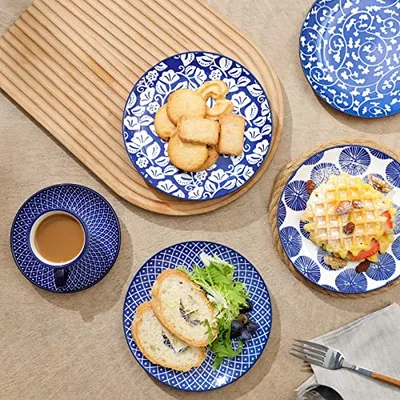
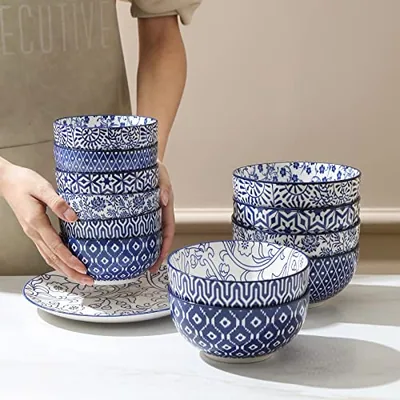
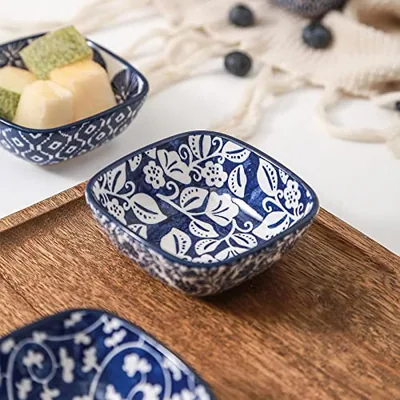
30-Pieces Ceramic Dinnerware Sets for 6
Set of 30 · 10" · 26 oz · Ceramic
4.7★ · 1,407 ratings as of August 2026
$159.99
Nora Beckett · Published 24 August 2026 · Updated 24 August 2026
Assorted sets do half the work. The other half is what you put beside them, and there are only three rules worth following.
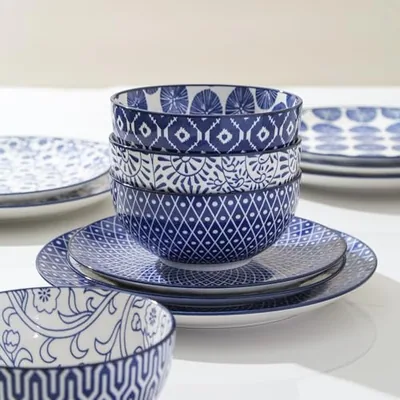
The reason an assorted set works at all is that every pattern in it shares a palette. Six different cobalt prints on a white body read as one idea. The same six prints in six unrelated colours would read as a jumble.
So the first rule is the easiest: mix inside a line before you mix across lines.
Pick the constant and stick to it. Usually it is colour, sometimes it is the shape of the rim, occasionally it is the finish. Two constants is safer than one when the patterns are busy.
The plain pieces in the printed line exist for this job. A patterned dinner plate under a plain bowl looks deliberate. Two busy patterns stacked look like an accident.
Set of 30 · 10" · 26 oz · Ceramic
4.7★ · 1,407 ratings as of August 2026
Set of 4 · 6" · 5 oz · Porcelain
4.8★ as of August 2026
Set of 6 · 4.7" · 12 oz · Ceramic
4.8★ · 1,192 ratings as of August 2026
Set of 6 · 3" · 2.6 oz · Ceramic
4.8★ · 1,067 ratings as of August 2026
Patterns fight when they are the same size. A dense small-scale print under a wide open one reads as depth. Two dense prints together read as noise.
A quick test: stand back three steps. If you cannot tell where one plate ends and the other begins, one of them needs to be plainer.
A patterned plate on a patterned cloth needs help. Wood, linen and plain glass are the usual rescue, and they are also what most kitchens already own.
If everything on the table has a pattern, take one thing out rather than adding a fourth.
The safest mix across lines is one patterned and one plain: cobalt plates under plain bowls, or coloured bowls on plain plates. Both give the eye somewhere to rest.
The riskier mix is two patterned lines together, and it works only when the scales differ. A dense small print under a wide open one reads as depth. Two dense prints touch and fight.
Nora Beckett writes the guides here. She sets a table most days, has broken more plates than she likes to admit, and measures shelves before she buys anything. What she knows comes from a lot of dishes washed, stacked and occasionally chipped.