Ceramic 12 Oz Dessert Bowls Set
Set of 6 · 4.7" · 12 oz · Ceramic
4.8★ · 467 ratings as of August 2026
$26.99
Resistant is not proof. The fired porcelain Selamica prints on is hard and it is brittle: it survives a stack, a dishwasher and a hot dish beside it, and it does not survive the rim of a steel sink at speed. Chip and scratch resistant is a claim about the glaze, and the floor is still the floor.
Resistant, not proofThe phrase describes hardness. It is not a promise about a tiled floor.
Where chips happenAt the sink, in the stack and in the dishwasher basket. Almost never at the table.

Three habits do most of the work. Do not stack plates wet, because the film of water lets them slide and knock. Do not rinse a plate against the tap edge. Do not move a piece straight from the fridge into a hot oven, and keep plates and bowls out of the oven altogether: only the bakeware and the ramekins are stated oven safe.
A chipped rim is worth retiring from the table. The glaze is what keeps the surface watertight, so once it is broken the piece is better off holding keys by the door than holding soup. Buy the shape you use most in a set, and a chip costs you one plate rather than the look of the table.
If it arrives chippedKeep the packaging until the set is unwrapped and counted. A chipped rim is a delivery matter, and it is settled where the order was placed.
Set of 6 · 4.7" · 12 oz · Ceramic
4.8★ · 467 ratings as of August 2026
The three habitsStack dry. Do not rinse against the tap. Do not let plates rattle against one another in the basket.
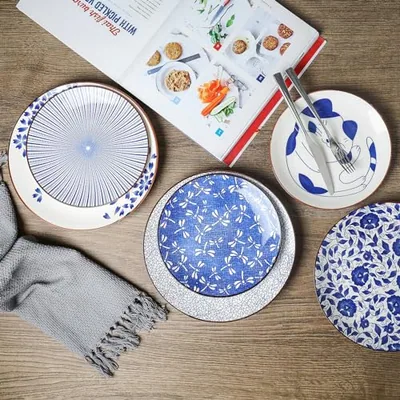
Every piece here is stated dishwasher safe, and printed porcelain survives it because the pattern sits under a fired glaze rather than on top of it. What wears is not the print but the shine, and that comes from detergent strength and heat rather than from the number of cycles.
Load plates so they cannot touch and rattle. The damage a dishwasher does to dinnerware is almost always contact damage, not chemistry.
Grey marks that look like scratches are usually metal transfer from cutlery. They come off with a paste of bicarbonate and a soft cloth, and they are not damage to the glaze.
Anything with a wooden element is the exception worth washing by hand: the machine damages the wood long before it touches the ceramic.
Set of 6 · 10" · Ceramic
4.8★ · 2,337 ratings as of August 2026
Set of 6 · 10" · Porcelain
4.8★ · 2,337 ratings as of August 2026
Set of 6 · 10" · Porcelain
4.8★ · 2,337 ratings as of August 2026
Stack dry, never wet. A film of water lets plates slide against one another, and the rim is the thinnest part of any plate. Six plates stand about 3.3–5.1 inches, and bowls take 8.4–13.2 inches because they nest only partly.
If a cupboard shelf is tight, split a set of six into two stacks of three rather than forcing one. Two short stacks also come out of a cupboard one-handed, which is when most breakages happen.
Shelf height, cupboard depth and the width of a dishwasher slot. Three numbers, one tape measure.
Two short stacks beat one tall oneThey come out of a cupboard one-handed, and that is when most breakages happen.
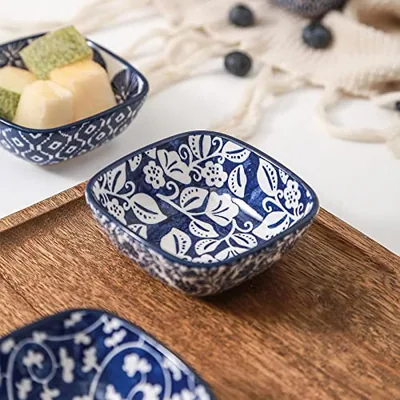
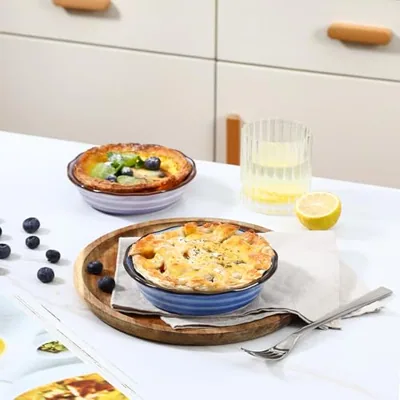
Microwave: stated safe across the range. Oven: only the bakeware and the ramekins, and only the pieces whose own product page says so. A plate that has been in a hot oven and meets a cold counter can crack straight across, and that is thermal shock rather than a fault.
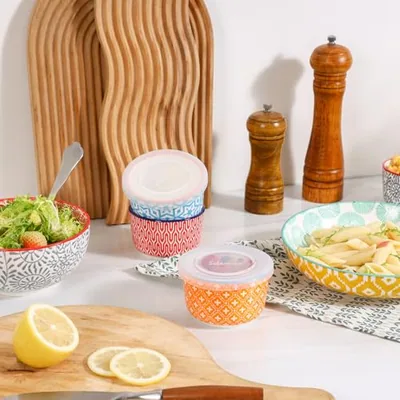
Freezer and fridge: the ramekin lids exist for the fridge, not for the oven. We do not repeat the product page’s general bullet about ovens on pages where it does not apply, because a bullet written for one product family should not decide what you do with another.
Set of 6 · 3" · 2.6 oz · Ceramic
4.8★ · 1,067 ratings as of August 2026
Set of 6 · 6 oz · Porcelain
4.7★ · 500 ratings as of August 2026