10 Inch Kitchen Serving Plates
Set of 6 · 10" · Ceramic
4.8★ · 2,337 ratings as of August 2026
$41.39
Nora Beckett · Published 24 August 2026 · Updated 24 August 2026
Why a fired print survives the machine, what actually dulls over time, and how to load so nothing chips.
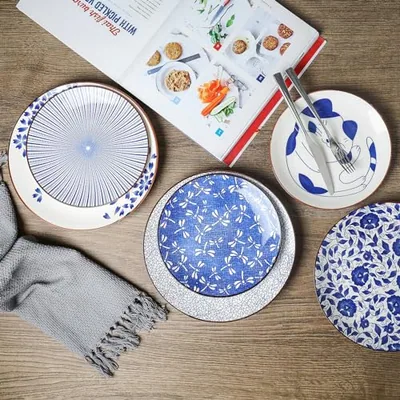
A fired, glazed surface is glass. Detergent does not reach the print through it, and the pattern on a properly fired piece outlives the plate’s own rim.
What can dull is the glaze itself: strong detergent and high heat, cycle after cycle, take the shine down before they take anything else.
Contact, not chemistry. Plates that touch rattle, and a rattling rim is the single most common way a plate chips in a machine.
The second is metal. A knife left against a plate leaves grey marks that look like scratches and usually wipe off with a paste of bicarbonate.
Set of 6 · 10" · Ceramic
4.8★ · 2,337 ratings as of August 2026
Set of 6 · 10" · Porcelain
4.8★ · 2,337 ratings as of August 2026
Set of 6 · 10" · Porcelain
4.8★ · 2,337 ratings as of August 2026
Set of 6 · 8" · Porcelain
4.8★ · 2,337 ratings as of August 2026
Space plates so they cannot touch, and put bowls at an angle so water leaves rather than pools. Ramekins go on the top rack, and their lids go beside them rather than on them.
Everything in the range is stated dishwasher safe. That is a claim about the material, not permission to wedge six plates into four slots.
For most of the range it is not. The exception is anything with a lid or a wooden stand, where the wood is what the machine damages rather than the ceramic.
If a piece came with a wooden element, wash that part by hand and let the ceramic take the machine.
Powder is harsher than gel, and the hottest cycle is harsher than both. Neither reaches a fired print, but together they take the shine off a glaze faster than years of washing by hand.
Use the shortest cycle that gets the plates clean. A glaze that keeps its shine also keeps its colour looking right.
A white haze on a plate after a cycle is usually hard water rather than a worn glaze. Run a cycle with the machine empty and a cup of white vinegar on the top rack, and a mineral film lifts off while a scratched surface stays exactly as it was. That test costs an hour and settles the question.
Rinse aid helps for the same reason: water that sheets off leaves less behind to dry into a film. Where the water is very hard, dishwasher salt does more than any change of detergent, and neither of them touches the printed pattern under the glaze.
Nora Beckett writes the guides here. She sets a table most days, has broken more plates than she likes to admit, and measures shelves before she buys anything. What she knows comes from a lot of dishes washed, stacked and occasionally chipped.